
What is Hajj?
Share Topic Via


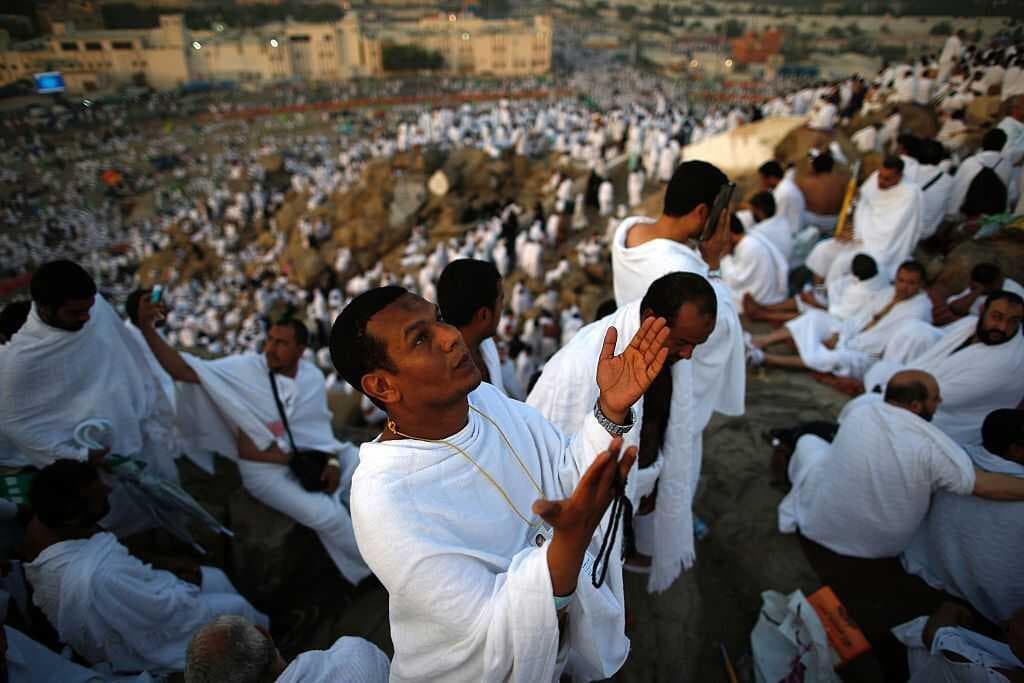
Hajj (Islamic pilgrimage) is Hajj is the fifth pillar of Islam. It’s one of Islam’s most publicized obligations, the last between them to be ordained, and it is to be obligatorily performed once in a lifetime by each capable Muslim, but they can still perform it optionally afterward whenever they want.
Hajj is ordained by God in the Quran (Islam’s book of revelation) as we find,
وَلِلَّهِ عَلَى ٱلنَّاسِ حِجُّ ٱلْبَيْتِ مَنِ ٱسْتَطَاعَ إِلَيْهِ سَبِيلًۭا ۚ
…And [due] to Allah from the people is a pilgrimage to the House (Ka’bah) for whoever is able to find thereto a way….”
[Quran,3:97]
Read the Full Article: What is Hajj?
When is hajj performed?
Hajj starts on the 8th and ends on the 12th day of the month Thul-Hijjah, the last month of each lunar Hijri year.
Moreover, the Hijri lunar calendar is shorter than the solar evangelic calendar by eleven days, so, Hajj actually moves around in the solar calendar yearly.
Indeed, hajj is the earth’s biggest annual gathering of people, two to three million people and even more gather to perform it from all over the globe.
Where is hajj performed?
Hajj is performed in Saudi Arabia, the country name now where the places people perform Hajj at exists. Assigned and taught by Muhammad (PBUH) those rituals of Hajj are done in the places shown in the following diagram:
Hajj rituals: 7 steps of the hajj in order
Hajj rituals take about five to six days. These rituals are taken from the Sunnah (way of application) of Muhammad, in a certain time, place and order. Here are the seven steps of hajj rituals in order:
1- Ihram:
Ihram is a state of purity and intention of performing Hajj. Men dress in a certain manner symbolizing unity and equality and women dress modestly. There is nothing to distinguish between them. It looks like a rehearsal for the Day of Judgment.
2- Tawaf and Sa’y
Then the pilgrim performs tawaf al Qudum (the welcome tawaf) and as Sa’y between the two mountains of Safa and Marwa.
Tawaaf (circumambulation) means that the person must walk counter-clockwise seven times around the Ka’aba (cube-shaped house built for the worship of the Single God Allah at Mecca) starting from the Black-stone corner. (Do Muslims Worship the kaaba and the black stone?)
As-Sa’y (Al-Safa and Al-Marwah) means that the pilgrims walk seven times between the two mountains of Al-Safa and Al-Marwah (it’s in imitation of Hagar’s search for water long ago leading to Zamzam water).
3- Going to Mina
After this, on the 8th day of Thul Hijjah, the pilgrim heads to Mina. He performs five prayers starting with the noon (dhur) prayer and ending with dawn (fajr) on the day of Arafat.
4- Moving to Arafat
On the 9th day of Dhul Hijjah, the pilgrims go to the plains of Mount Arafat, where the Prophet Muhammad gave his last sermon.
Being there is the most important ritual and step in hajj. That’s why when the Messenger of Allah Muhammad (PBUH) was asked one day about the hajj, he replied:
قَالَ رَسُولُ اللَّهِ صلى الله عليه وسلم “ الْحَجُّ عَرَفَةُ .
The Messenger of Allah said: “Hajj is Arafat.”
[Sahih Sunan An-Nasa’i]
For more about the day of Arafat, read this article: The Day Of Arafat 2023 – Meaning, Virtues
5- Spending the night at Muzdalifah
After Arafat, by the sunset of the 9th day of Dhul Hijjah, pilgrims move to Muzdalifah where they spend the night and gather pebbles in a certain number.
6- Ramy al Jamarat (throwing the pebbles)
The following step, on the 10th day of Dhul Hijjah, is that the pilgrims move again to Mina to perform the symbolic stoning of the devil ritual in which they fling pebbles at three walls known as Jamarat. This symbolizes how the devil tried to mislead Ibrahim (Abraham) (PBUH) from obeying Allah but was fought off when Ibrahim threw stones at him on three occasions.
7- Rituals on Eidul Adha:
Sacrifice, stoning, sa’y and others
On the tenth day of Thul-Hijjah to the thirteenth, the pilgrims may perform the ritual of animal sacrifice (Udhiyah), and ending their state of ihram by shaving the hair or shortening it. Then they continue with other rituals of stoning the devil to complete their Hajj for two or three days as they wish, and perform another Tawaf before departing.
For more about hajj pillars, duties and sunnah acts, read this article: Hajj Pillars, Duties, Sunnahs, and obligations – 2023 Full Guide
Also, you can know more about the types of hajj in Islam in this article: Types of Hajj in Islam: Hajj Ifrad, Hajj Qiran, and Hajj tamattu Explained!
8- Shave the Hair of Head
Then they can do the third rite, shave their heads head (for the male pilgrims) or trim it; women also cut the ends of their hair which marks the end of the state of ihram.
9- Throwing Stones
The forth rite on the day of Hajj, is to throw seven small stones at each of three pillars on three consecutive days (the pillars represent sins and devils). This forth rite is repeated for the next 2-3 days, as per the person’s choice. (Read the Pillars of Hajj)
10- returning to Mecca
Then the pilgrim returns to Mecca, where he or she once again performs the farewell Tawaf (circumambulation of the Ka’ba). And that’s where the journey ends.
Why Muslims perform hajj?
Muslims perform Major Pilgrimage (Hajj) and Minor Pilgrimage (Umrah) seeking forgiveness of Allah for their sins, rewards for their efforts and obedience, and Allah’s pleasure. Abu Hurairah (May Allah be pleased with him) reported: The Messenger of Allah (PBUH) said,
(The performance of) ‘Umrah is an expiation for the sins committed between it and the previous ‘Umrah; and the reward of Hajj Mabrur (i.e., one accepted) is nothing but Jannah.”
[Bukhari and Muslim]
Also, Hajj is for worldly benefits, remembrance of God, and Taqwa (Piety). That is what a pilgrim comes back baring; whatever profit of business he has done, rewards for the obedience he fulfilled, and piety in his heart after his records have been cleared of all previous sins. Piety is to be as a shield against straying away from the righteous way.
Conclusion
To conclude, Hajj in Islam is an ordination from Allah on every capable Muslim (physically, financially and can safely perform it). Hajj is where all distinction between people is eliminated; all people are wearing the same clothes, and doing the same things, in the same way, time, and place. It’s a sign of total submission and obedience to Allah, and a turning point in a Muslim’s life.
Share Topic Via
